
A joint SEA-Quester and POMP webinar series.
The POMP and SEA-Quester projects are funded under the same call topic (HORIZON-CL6-2023-CLIMATE-01-3: Ocean and coastal waters carbon- and biodiversity-rich ecosystems and habitats in Europe and the Polar Regions). By coming together, both projects aim to amplify the impact of each project to share progress, promote collaboration, and advocate for an improved knowledge on polar blue carbon and biodiversity. The two projects will work together to complement each other towards common goals through joint initiatives such as a webinar series.
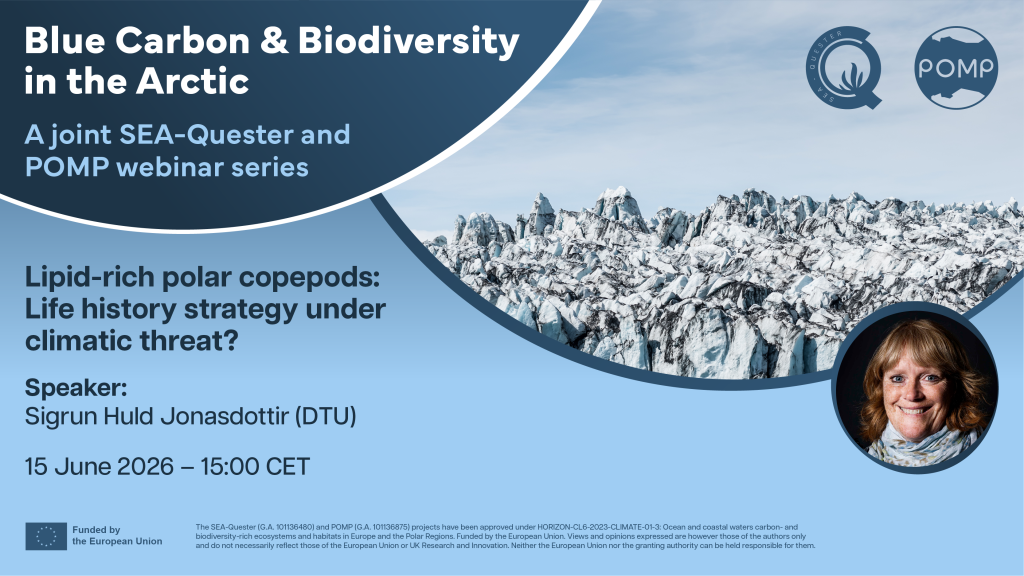
Title: Lipid-rich polar copepods: Life history strategy under climatic threat?
Date & time: 15 June 2026, 15:00 CET
Speaker: Sigrun Huld Jonasdottir (DTU)
Sigrún calls herself a marine lipid ecologist, with special focus on lipid-rich copepods in the North Atlantic and Arctic Ecosystems. She is interested in the function of lipids in the life history strategy of copepods, as well as their role in active carbon transport and sequestration during diapause.
Abstract: The central role of lipids in the ecology of high latitude seas is under threat by global change. This hinges on tight ecological link between diatoms and copepods of the genus Calanus, that produce and accumulate energy-rich lipids. Strongly coupled through seasonal water column stability, nutrient supply, spring bloom succession and overwintering life strategies, this nexus is foundational to the highly productive food webs of Arctic/sub-Arctic North Atlantic. We report that the ability of Calanus finmarchicus to accumulate lipids is seriously impaired by changing plankton community and by rising temperatures, being 3 times higher on diatom than flagellate based diets while suffering around a 60% reduction associated with a 2o C temperature change. This together with higher respiration rates, smaller size at maturity and reduced diatom productivity suggests their ability to overwinter will be compromised, threatening not only their contribution to regional productivity but also in maintaining a significant pool sequestered carbon via the lipid pump.
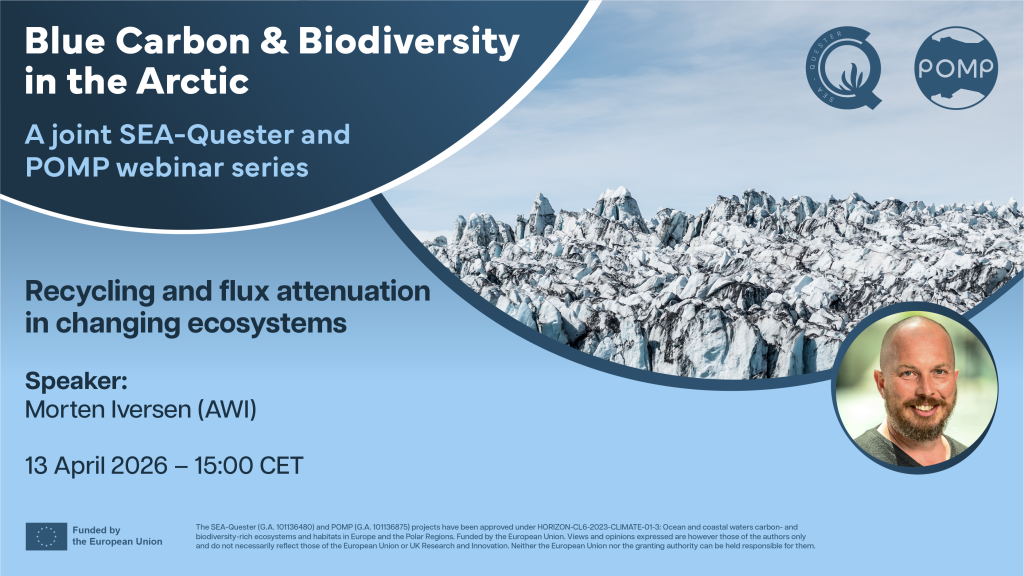
Title: Recycling and flux attenuation in changing ecosystems
Date & time: 13 April 2026, 15:00 CET
Speaker: Morten Iversen (AWI)
Abstract: The ocean’s biological carbon pump maintains the vertical gradient of carbon in the ocean by linking microbial processes on sinking particles with global carbon sequestration in the deep sea. This seminar will explore the mechanisms driving the biological carbon pump across scales – from microscale particle colonization to large-scale ecosystem shifts. We will examine how aggregate morphology and small-scale fluid dynamics determine where and how microbes attach to marine snow, influencing nutrient recycling and carbon export. Building on this, we will discuss how zooplankton feeding, repackaging, and fragmentation modulate particle flux attenuation in the upper ocean, shaping both the strength and depth of the carbon pump. At larger spatial scales, climate-driven changes in plankton communities, particle composition, and trace-metal recycling are altering the biological carbon pump’s capacity to sequester carbon. Our research highlights the need to better understand how the organic composition of settling aggregates evolves as they degrade and age through the water column, and how zooplankton and microbial activity drive nutrient regeneration and transformation between dissolved and particulate organic matter. The biological carbon pump is a living, dynamic system and its future role in Earth’s climate will depend on how these interacting biological and biogeochemical processes respond to a changing ocean.
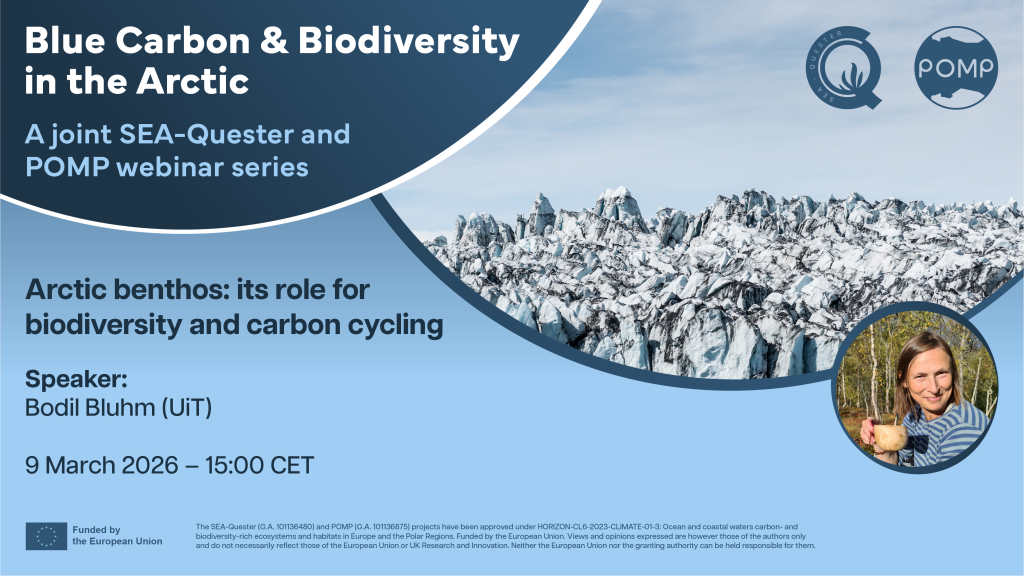
Title: Arctic benthos: its role for biodiversity and carbon cycling
Date & time: 9 March 2026, 15:00 CET
Speaker: Bodil Bluhm (UiT)
Bodil Bluhm is a professor in Arctic marine ecology at UiT The Arctic University of Norway at the Dept. of Arctic and Marine Biology. She got her academic training at the Inst. of Polar Ecology at Kiel University and Alfred Wegener Institute in Germany and subsequently worked at the College of Fisheries and Ocean Science at the University of Alaska Fairbanks. Her research focus is on benthic taxonomic and functional diversity, food webs, and benthic- pelagic coupling in the marine Arctic.
Abstract: The webinar will present insights on patterns and functional roles of Arctic seafloor fauna from a suite of recent and ongoing pan-Arctic activities and regional case studies.
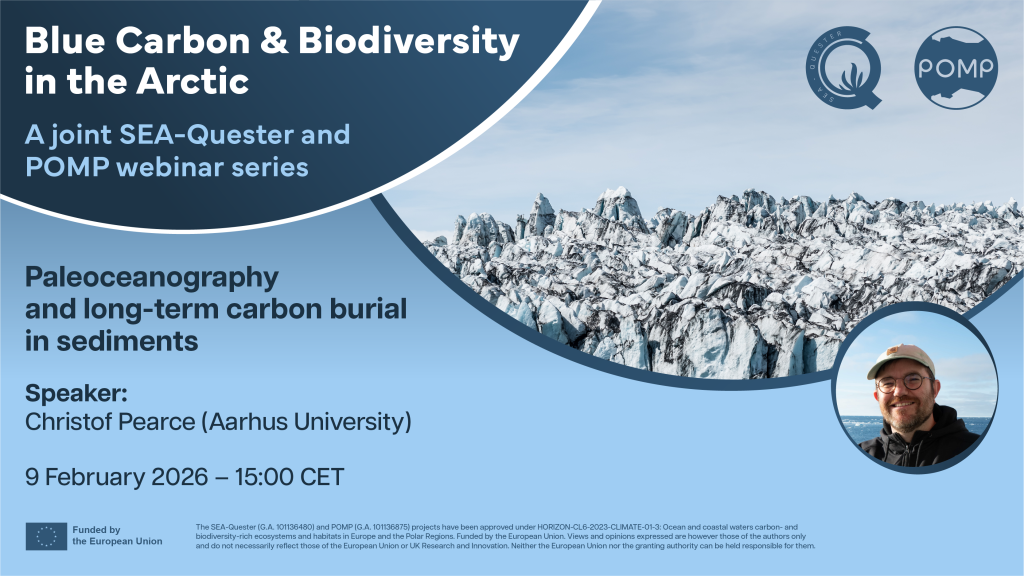
Title: Paleoceanography and long-term carbon burial in sediments
Date & time: 9 February 2026, 15:00 CET
Speaker: Christof Pearce (Aarhus University)
Abstract: Christof’s research deals with Arctic paleoclimatology and paleoceanography with a particular focus on the history of the Greenland Ice Sheet and the role of ocean circulation in climate variability. To reconstruct past conditions, Christof works with marine sediments and uses various biological, physical, and geochemical proxies. In SEA-Quester, Christof is studying the range of carbon burial in Arctic marine sediments under different climate and environmental conditions.

Title: Macroalgae and blue carbon in the Arctic
Date & time: 12 January 2026, 15:00 CET
Speaker: Dorte Krause-Jensen is a professor in marine ecology at the Department of Ecoscience, Aarhus University, Denmark. Her research focuses on the ecology of coastal and marine vegetated ecosystems, particularly seagrass meadows and macroalgal forests.
Abstract: The webinar addresses Arctic macroalgae, particularly habitat-forming brown macroalgae such as fucoids and kelps, and their potential to contribute to carbon sequestration in the Arctic via export to carbon sink beyond the coastal habitats.