
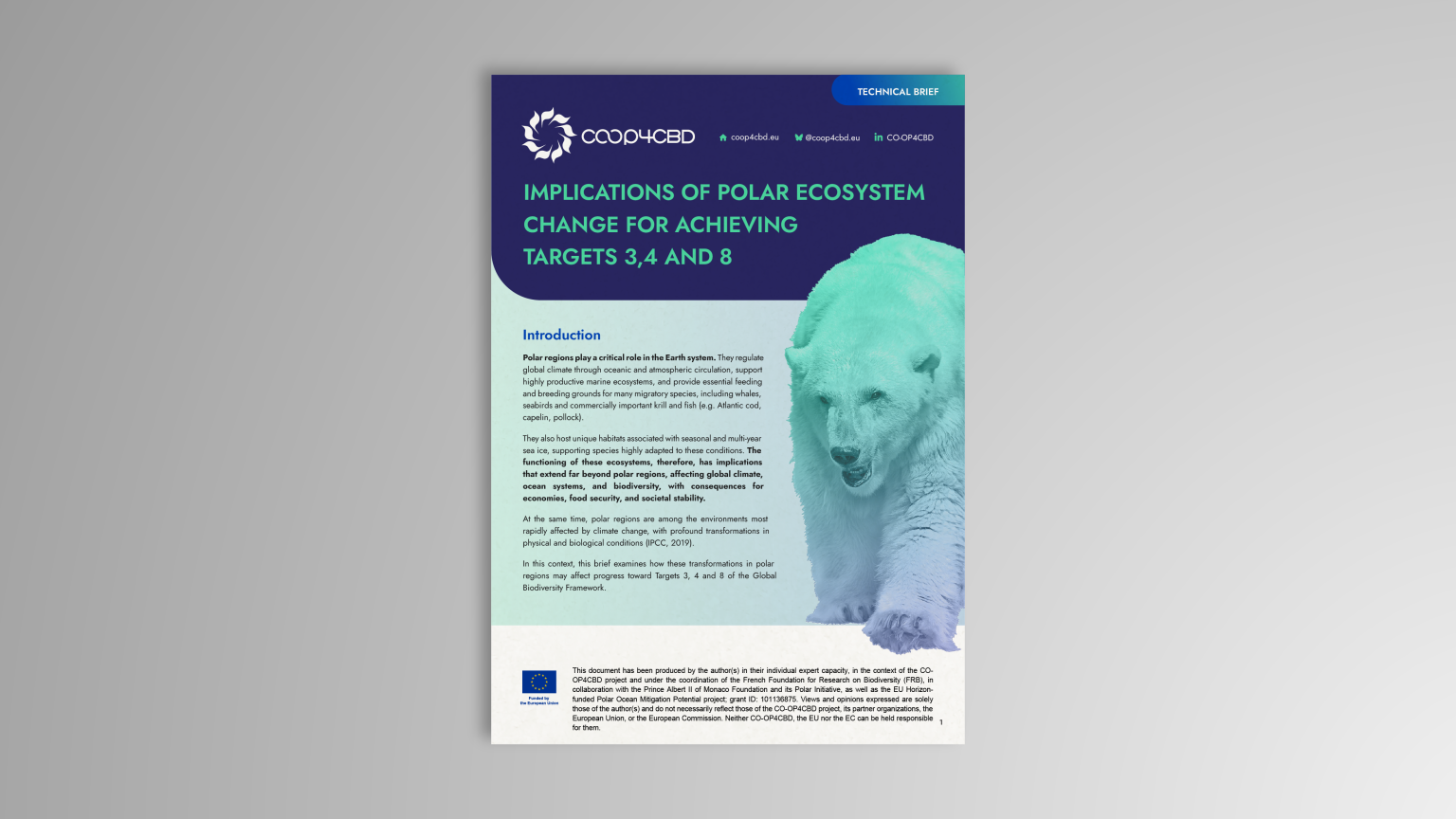
POMP has contributed to a new CO-OP4CBD Technical Brief examining how rapid changes in polar ecosystems could affect progress towards three key targets of the Kunming–Montreal Global Biodiversity Framework.
The brief, Implications of Polar Ecosystem Change for Achieving Targets 3, 4 and 8, focuses on area-based conservation, species conservation, and the links between climate change and biodiversity. It was developed by CO-OP4CBD in collaboration with the Prince Albert II of Monaco Foundation and its Polar Initiative, as well as the Horizon Europe POMP project.
POMP contributed scientific and policy expertise to the publication, including through POMP scientists Bodil A. Bluhm and Paul E. Renaud, who are among the brief’s lead authors.
The brief explains that polar ecosystems are undergoing rapid and systemic transformations due to climate change and sea-ice decline. These changes are altering food webs, species distributions and ecologically important areas, while creating growing challenges for conservation and management systems that were often designed around relatively stable environmental conditions.
To address this mismatch, the authors highlight the need for adaptive and precautionary approaches to protected areas, fisheries and spatial management. Conservation measures must be able to respond to shifting habitats and species distributions while integrating new scientific knowledge as it becomes available. The brief also stresses that these actions must be supported by rapid global reductions in greenhouse gas emissions.
This contribution reflects POMP’s commitment to connecting polar science with policy. By improving knowledge of how changing marine ecosystems support biodiversity and regulate carbon, POMP is helping develop a stronger basis for protecting polar habitats and their contribution to climate change mitigation.
Read the technical brief and explore the full collection of CO-OP4CBD Technical Briefs: https://zenodo.org/records/21669097